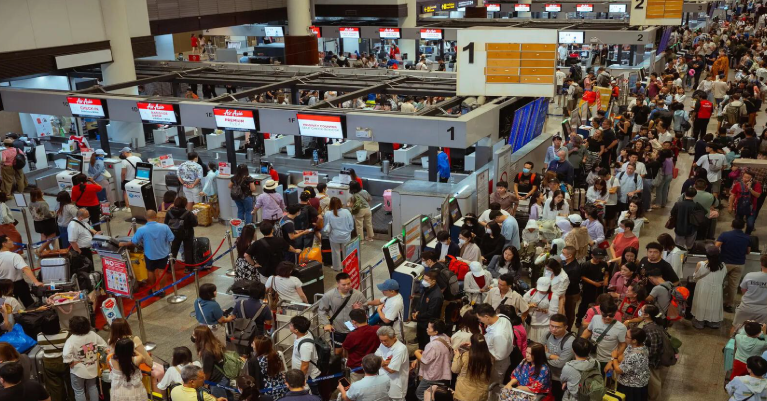

A traveller sees a flight confirmation, a hotel booking, and an itinerary.
Behind that seemingly simple journey is something far more complex: a connected ecosystem of people, technology, suppliers, decisions, and processes working together to deliver a seamless travel experience.
That complexity is easy to overlook because, when everything works, travellers rarely see it. Yet tourism is, in many ways, a vast operating ecosystem — one that relies on thousands of interactions across airlines, hotels, travel agencies, technology providers, ground operators and support teams. .
In 2025, Travel & Tourism supported 366 million jobs worldwide, accounting for 10.9% of global employment, according to the World Travel & Tourism Council (WTTC). The sector is projected to support another 10 million jobs in 2026, reflecting the continued scale and economic significance of the industry.
As the industry grows, so does the complexity behind every journey. Technology is transforming how travel is sold and serviced, customer expectations are rising, and travel businesses are managing increasingly connected systems and operations.
That makes one thing increasingly clear: the future of tourism won’t be powered by technology alone. It will depend on the people who understand how to operate, adapt, and improve the systems behind it.
A Traveller Sees a Journey. A Tourism Business Sees an Ecosystem.
Consider a relatively straightforward trip: Singapore to Sydney, then on to Brisbane.
For the traveller, it may be little more than a booking, two flights, and a destination.
Behind the scenes, however, that journey can involve fare management, availability checks, ticketing, GDS and travel systems, payment processes, schedule monitoring, customer support, and coordination across multiple suppliers.
And that’s before anything goes wrong.
A schedule change can turn a straightforward itinerary into a chain of operational decisions. Someone needs to identify alternative inventory, validate fare rules, rebook the traveller, reissue the ticket, communicate the change, and ensure the financial transactions are accurately reconciled. The traveller may simply see a notification saying their flight has changed.
The operation sees everything that has to happen next.
That is where the industry’s invisible workforce plays a critical role —not necessarily to the traveller, but in the quality of the experience they ultimately receive.
Travel consultants, ticketing specialists, customer support teams, revenue and finance professionals, technology specialists, and quality teams each play a role in keeping these interconnected processes moving — often across different systems, time zones, and points of customer journey.
The Tourism Workforce Is Changing.
The people behind tourism are also working in an industry that looks different from the one they entered.
Travel is becoming more digital, more connected, and increasingly shaped by changing customer expectations.. IATA’s latest work on Modern Airline Retailing highlights the industry’s shift toward more personalised, digital experiences, while its 2025 research shows that 54% of travellers prefer to deal directly with airlines, increasingly through mobile apps.
For travel professionals, that means technology is not just a tool sitting alongside the job. It is becoming embedded in how the job is performed.Professionals are expected to navigate multiple systems, manage customer interactions across channels, adapt to evolving distribution models, and make increasingly complex decisions at speed. At the same time, automation is taking on more routine processes, shifting human attention toward the situations technology cannot easily resolve.
As the operating environment changes, so does the capability required to work effectively within it.
The World Economic Forum estimates that 39% of workers’ core skills will change by 2030, while AI, big data, technological literacy, creative thinking, resilience, flexibility, and lifelong learning are all expected to become increasingly important.
For tourism organisations, the challenge isn’t simply finding people. It is building the capability to keep their knowledge current, their skills relevant, and their workforce ready for what the industry demands next.
Technology Changes the Work. Expertise Makes the Transition Smooth.
There is a temptation to frame the future of travel as a choice between people and technology.
It isn’t.
Automation can handle repetitive tasks. AI can surface information, identify patterns, and augment decision-making. Digital systems can connect data and reduce manual effort.
But travel rarely follows a perfect script.
When a traveller’s itinerary breaks down, when inventory changes unexpectedly, when a fare rule complicates a rebooking, or when several systems produce conflicting information , someone still needs to understand the context and decide what should happen next.
In this way, human expertise becomes more valuable—not less.
As technology takes care of more routine work, the role of people increasingly shifts towards judgement, exceptions handling, problem-solving, and the decisions that require context and experience.
IATA’s work on modern airline retailing reflects this broader shift. As airlines move toward more connected Offers & Orders models, the industry is not simply changing its technology; it is changing how products are sold, serviced, and accounted for across the journey. That transition requires people who understand both the systems and the business behind them. And that knowledge cannot be built overnight.
Expertise Has to Be Built, Not Assumed.
This is where training becomes an operational issue—not simply an HR initiative.
When systems change, people need to understand them. When processes evolve, knowledge needs to move with them. And when new technology is introduced, teams need to know not only how to use it, but when to question it, intervene, or take over.
The World Economic Forum’s findings reinforce the scale of the challenge: 63% of employers identify skills gaps as a major barrier to business transformation, while half of workers surveyed had completed training, reskilling, or upskilling as part of longer-term learning strategies.
In travel, this matters because expertise is cumulative. It comes from understanding the systems, navigating exceptions, and sharing knowledge across teams.
At ATI, this principle is reflected through ATI Academy, which delivers 15,980+ annual training hours, supported by trainers with an average of 12 years of experience, across 116 GDS and travel systems.
The numbers matter, but the broader lesson matters more: operational capability has to be continuously maintained as the industry changes.
The Workforce Behind the Future of Tourism.
Tourism’s next chapter won’t simply be about having more travellers, more technology, or more capacity. It will be about how effectively the industry brings people, process, and technology together.
As the industry evolves, the professionals behind tourism will need to understand complex systems, work alongside automation, manage exceptions, and continuously build their expertise.
World Tourism Day is often an opportunity to look at the destinations, experiences, and journeys that make tourism possible. But behind every one of them is an operational reality that travellers rarely see.
Every journey has a destination. Getting there depends on an ecosystem of people, processes, and technology working together behind the scenes.
Sources:
World Travel & Tourism Council. (2026, April 14). Travel & Tourism Sees Best Year Ever and Emerges as the World’s Fastest Growing Sector, Outpacing the Global Economy in 2025.
World Travel & Tourism Council. (2026, May 12). Global Travel & Tourism Growth to Outpace Wider Economy by 1.5 Times Over the Next Decade.
IATA. (2025, November 5). IATA’s 2025 Global Passenger Survey Reveals Mobile and Digital ID as the Future of Travel.
IATA. (2025, June 1). Making Sense of Orders: A Key Step in the MAR Journey.
World Economic Forum. (2025, January 7). Opportunities by 2030 but Urgent Upskilling Needed to Prepare Workforces.